
AI Assistant
Completed

Business Assessment Report


Jan 2024 - Jan 2025

Approved By :


Nasser Jaber H a Al- marri
Head of Security, Safety and Facilities Affairs Unit

TABLE OF CONTENT

INTRODUCTION

01

OBJECTIVE OF ACTIVITY

02

STRUCTURE OF THE REPORTING ADOPTED

03

MAIN COMPONENTS IN THE PDCA CYCLE

04

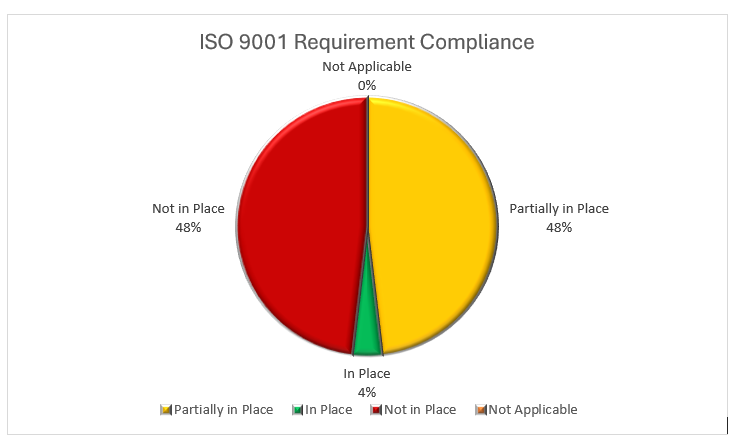
SUMMARY OF GAP ASSESSMENT

05

OBSERVATIONS IN EACH PHASE OF THE PDCA CYCLE

06

OPERATIONAL PROCEDURES REQUIREMENT

07

OPERATIONAL PROCEDURES REQUIREMENT

08

1.INTRODUCTION

The project aims to assist, develop, and implement quality management systems and achieve certification to ISO 9001:2015 standards.

This report details the gap analysis results to ISO 9001:2015 Standard performed by Excelledia Quality Consulting, along with the focal points and relevant representatives from INTALEQ.

2. OBJECTIVE OF ACTIVITY

The objective of the gap analysis is to evaluate the current practices of INTALEQ against the requirements of ISO 9001:2015 standard. This would enable the organization to identify any gaps that must be addressed and establish, develop, and implement an effective quality management system.

3. STRUCTURE OF THE REPORTING ADOPTED

The details mentioned in this report follow the Plan, Do, Check, and Act (PDCA) Cycle as outlined in the ISO 9001:2015 standard.

Section 5 of this document provides an overview of the Assessment considering the main components in every phase of the PDCA Cycle as identified in Section 4

Section 6 of this document provides a detailed report of the observations in each phase of the PDCA cycle, which provides:

(A) Title of Requirements

(B) Current Status of the Quality Management System

(C) Gap Observed against QMS Requirements

(D) Action plan

(E) Responsibility

Section 7 of this document provides a list of operational procedures to be developed to support the Quality Management System requirements.

Section 8 of this document depicts the essential actions to be taken to ensure compliance with ISO 9001:2015 requirements.

Page 1

4. MAIN COMPONENTS IN THE PDCA CYCLE
‘In-Place’ System where standard requirements found suitably addressed and implemented
‘Partially in-place’ is where standard requirements found not suitably addressed and practiced
‘Not in-place’ where standard requirements found not completely addressed and implemented
‘Not applicable’ where requirement is not applicable to the departments

PDCA Cycle - ISO 9001:2015

  1. Clause 4: Context of Organization
    Clause 5: Leadership
    Clause 6: Planning
    Clause 7: Support

    Plan
  2. Clause 8: Operations
    Do
  3. Clause 9: Performance Evaluation
    Check
  4. Clause 10: Improvement
    Act
5. SUMMARY OF GAP ASSESSMENT
  • Legal Identity: The lab’s legal identity is clearly defined as the University of Doha for Science and Technology.
  • Certified Reference Materials (CRMs): CRMs produced by CPA-Chem are available and ISO 17034 accredited RMP by ANAB.
  • Equipment Availability: Most required equipment is already in place, indicating a good level of preparedness for testing.
  • Existing SOPs: SOPs and worksheets prepared by the Construction Lab were found to be mostly in order.

Page 2

6. OBSERVATIONS IN EACH PHASE OF THE PDCA CYCLE
Answers

Score : 30

Support File
Drag & Drop Your File Here
Certificate.png
96KB
Comment
Action Plan
Responsive User
Jasica Williams
Team Lead
Start Date

Jan 12,2020

Target Date

Jan 12,2020

Responsive User
Jasica Williams
Team Lead
Start Date

Jan 12,2020

Target Date

Jan 12,2020

The organization should actively involve all stakeholders in the Quality Management System (QMS) review process. The QMS should be embedded in the organization's business processes and discussed at board meetings. Minutes should be taken detailing the attendees, discussions, and action points agreed upon. The organization should use a process-based approach when setting or reviewing its internal processes, actively review its risks and opportunities, and employ an effective internal audit system with corrective actions where necessary. Appropriate monitoring and measuring systems should be used to assess specific areas. Finally, the quality policy and objectives should be established with the active involvement of all stakeholders.

Developing quality policy within the INTALEQ context and scope to be approved by the top management requires periodic review. Communicate to interested parties as well.

A job description and competency matrix must be developed and communicated to employees to ensure clarity and understanding.

The risk management mechanism should be developed by INTALEQ for each identified risk, including its severity and likelihood, along with corresponding mitigation plans.

Create specific quality objectives, key performance indicators (KPIs), and action plans with monitoring scores for each department or process.

Develop a change management process encompassing supplier changes, process execution, management systems, and design alterations.

A detailed asset management policy must be developed, including equipment, tools, hardware, software, etc. A job description and competency matrix must be developed and communicated to employees to ensure clarity and understanding.

Implement a comprehensive awareness program to educate employees about the QMS. Develop a system for communicating changes and updates to all stakeholders promptly.

Develop INTALEQ communication matrix.

Develop a document management system to ensure easy access and organization of documents. Establish procedures for updating and approving documents by authorized personnel.

Develop ICT project management procedure, which includes Planning, Design, Execution, Validation, and Maintenance Support.

Develop a process for managing customer inquiries, contracts, orders, changes, feedback, and complaints.

Include design and development in project management procedures to ensure validation aligns with project specifications.

The procurement policy should be revised to incorporate performance evaluations.

Develop ITP for all ICT services.

Develop a mechanism for capturing and recording all internal and external issues, investigating them, and taking appropriate corrective action.

Define clear performance indicators aligned with organizational goals and QMS objectives. Establish clear criteria and methods for monitoring and measuring performance indicators.

Develop a system to collect feedback and monitor the perceptions.

Develop a procedure to complete the internal audit program to cover all operations and activities. Assess risks, train auditors, track findings, and communicate results to stakeholders.

Establish a yearly management review schedule. Collect and analyze relevant information. Develop a structured agenda covering KPIs, risks, and opportunities. Document decisions and actions and assign implementation responsibilities. Monitor progress on implementing action plans.

Set up clear and easy-to-follow protocols for reporting and investigating issues that don't meet the required standards. Train the staff to identify, write, and examine these issues. Conduct a thorough analysis to identify the root causes of the problems. Take effective and timely corrective actions to address the issues and prevent them from reoccurring. Establish a systematic process to identify, evaluate, and implement opportunities for improvement. Encourage and reward employees for their suggestions for improvement. Monitor and measure the effectiveness of the corrective actions and improvement initiatives. Share the improvement goals and outcomes with all the relevant stakeholders.

7. OPERATIONAL PROCEDURES REQUIREMENT
  1. Project Management

    The high-level process includes planning, analyses, design, build, and validation of all kinds of services INTALEQ provides.

  2. ICT Policies

    Policies include ICT governance, infrastructure, application, service management, security, implementation and reviews, exceptions, roles and responsibilities, monitoring, and evaluations.

  3. Document and Record Control

    The high-level process includes creating, updating, and retailing all documents and records.

  4. Control of Non-Conformance and Corrective Action

    To manage all types of INTALEQ internal and external nonconformities.

  5. Management Review

    To conduct a regular management review of the effectiveness of QMS.

  6. Marketing and Customer Interface

    To handle customer inquiries, any changes, and managing customer satisfaction.

  7. Internal Audit

    Conduct periodic audits to ensure the QMS system compliance.

  8. Asset Management

    To manage all assets owned by INTALEQ and the service histories.

  9. Organization Context

    To identify and validate all types of business risks.

  10. Change Management

    To address all kinds of significant changes that may affect INTALEQ operations.

  11. Risk Management

    Develop a process to ensure risk and opportunity in line with IMS are identified, analysed and addressed.

  12. Venue Management Projects

    Develop procedure for Venue management projects.

8. KEY ACTIONS TO BE TAKEN
ID Action Plan Due Date Responsible Person
1

Identify the stakeholders of BCM and document

Stakeholder requirements refer to the expectations, needs, and obligations of individuals or groups that have an interest in an organization’s business continuity capabilities. These requirements guide the development, implementation, and maintenance of the Business Continuity Management System (BCMS) in alignment with NCEMA 7000:2021 and other relevant standards.
14-01-2021
Zachariya Parakkal
HR Generalist
2

Context of Organization

Development of Scope Document, Context, Identification of Stakeholders and their needs/expectations. Process interactions to be developed for all key activities
14-01-2021
Zachariya Parakkal
HR Generalist
3

Identify the stakeholders of BCM and document

Stakeholder requirements refer to the expectations, needs, and obligations of individuals or groups that have an interest in an organization’s business continuity capabilities. These requirements guide the development, implementation, and maintenance of the Business Continuity Management System (BCMS) in alignment with NCEMA 7000:2021 and other relevant standards.
14-01-2021
Zachariya Parakkal
HR Generalist
4

Identify the stakeholders of BCM and document

Stakeholder requirements refer to the expectations, needs, and obligations of individuals or groups that have an interest in an organization’s business continuity capabilities. These requirements guide the development, implementation, and maintenance of the Business Continuity Management System (BCMS) in alignment with NCEMA 7000:2021 and other relevant standards.
14-01-2021
Zachariya Parakkal
HR Generalist
5

Identify the stakeholders of BCM and document

Stakeholder requirements refer to the expectations, needs, and obligations of individuals or groups that have an interest in an organization’s business continuity capabilities. These requirements guide the development, implementation, and maintenance of the Business Continuity Management System (BCMS) in alignment with NCEMA 7000:2021 and other relevant standards.
14-01-2021
Zachariya Parakkal
HR Generalist
9. CONCLUSION

Lorem ipsum dolor sit amet, consectetur adipiscing elit. Ut venenatis tellus bibendum congue facilisis. Fusce rutrum ante non magna consectetur auctor in non urna. Integer convallis semper mi eu laoreet. Sed molestie risus id ullamcorper blandit. In eu placerat nibh, vitae tristique metus. Cras vel orci augue. Vivamus in velit luctus, pretium libero at, malesuada sem. Etiam pulvinar felis vitae odio dictum egestas. Sed efficitur convallis augue, eu gravida orci vehicula ut.

Lorem ipsum dolor sit amet, consectetur adipiscing elit. Ut venenatis tellus bibendum congue facilisis. Fusce rutrum ante non magna consectetur auctor in non urna. Integer convallis semper mi eu laoreet. Sed molestie risus id ullamcorper blandit. In eu placerat nibh, vitae tristique metus. Cras vel orci augue. Vivamus in velit luctus, pretium libero at, malesuada sem. Etiam pulvinar felis vitae odio dictum egestas. Sed efficitur convallis augue, eu gravida orci vehicula ut. Lorem ipsum dolor sit amet, consectetur adipiscing elit. Ut venenatis tellus bibendum congue facilisis. Fusce rutrum ante non magna consectetur auctor in non urna. Integer convallis semper mi eu laoreet. Sed molestie risus id ullamcorper blandit. In eu placerat nibh, vitae tristique metus. Cras vel orci augue. Vivamus in velit luctus, pretium libero at, malesuada sem. Etiam pulvinar felis vitae odio dictum egestas. Sed efficitur convallis augue, eu gravida orci vehicula ut.

×
Quarter
Q1 Q2 Q3 Q4
Is Auditor
Deesignation
Developer Designer
Sub Section
Interview
5